Mailer's Dick
Reflections on Norman Mailer’s infamous 1971 appearance on The Dick Cavett Show

Today marks the 51st[1] anniversary of Norman Mailer’s infamous 1971 appearance on The Dick Cavett Show, when the typically innocuous namesake was rendered Maury Povich for 25 brilliant minutes, arbitrating (and agitating) a petty conflict between two literary giants of the day—Gore Vidal and Norman Mailer.
The Vidal-Mailer feud, professional and personal in nature, was a part of the broader fracas surrounding the release of Mailer’s book, The Prisoner of Sex (1971). The book is one part eccentric, poetical meditation on sex (the act, and the category), one part prescient treatise on the Women’s Liberation Movement’s shortcomings (namely, its selective dishonesty and embrace of inhuman technology), and one part proto-flame war targeting feminist writer Kate Millet, with a spattering of controversial musings on sodomy to garnish.
Mailer wrote the original Harper’s Magazine essay that preceded Prisoner after learning he’d been identified by the Movement’s literati as public enemy no.1—a provocation he could not resist (“...better to expire a devil in the fire than an angel in the wings'', he writes in the book’s first chapter). The controversy surrounding the texts inspired the organization of a “debate” between Mailer and four prominent feminists, which had the flattering effect of equating the one Mailer to four women, undermining the women’s arguments individually and collectively. The debate would be immortalized several years later in the release of the documentary Town Bloody Hall (1979).
Both the Hall and Cavett appearances make clear that Mailer has few qualms about looking the fool, giving him a distinct edge in such spectacles. Yet, he plays relatively poorly on Cavett, where his combativeness reads as uncouth in comparison to the journalist Janet Flanner’s complacent wit, and Gore’s smooth, patrician detachment. By assuming the role of Conservative-bogeyman to the unimpeachable Gore’s smug Liberal, Mailer forfeits any sympathy he might have elicited from the audience for his being outnumbered. Who better to assume the role of “male chauvinist pig” than the pugilistic author who’d stabbed his second wife, and once said that “no sex is non-violent”[2]?
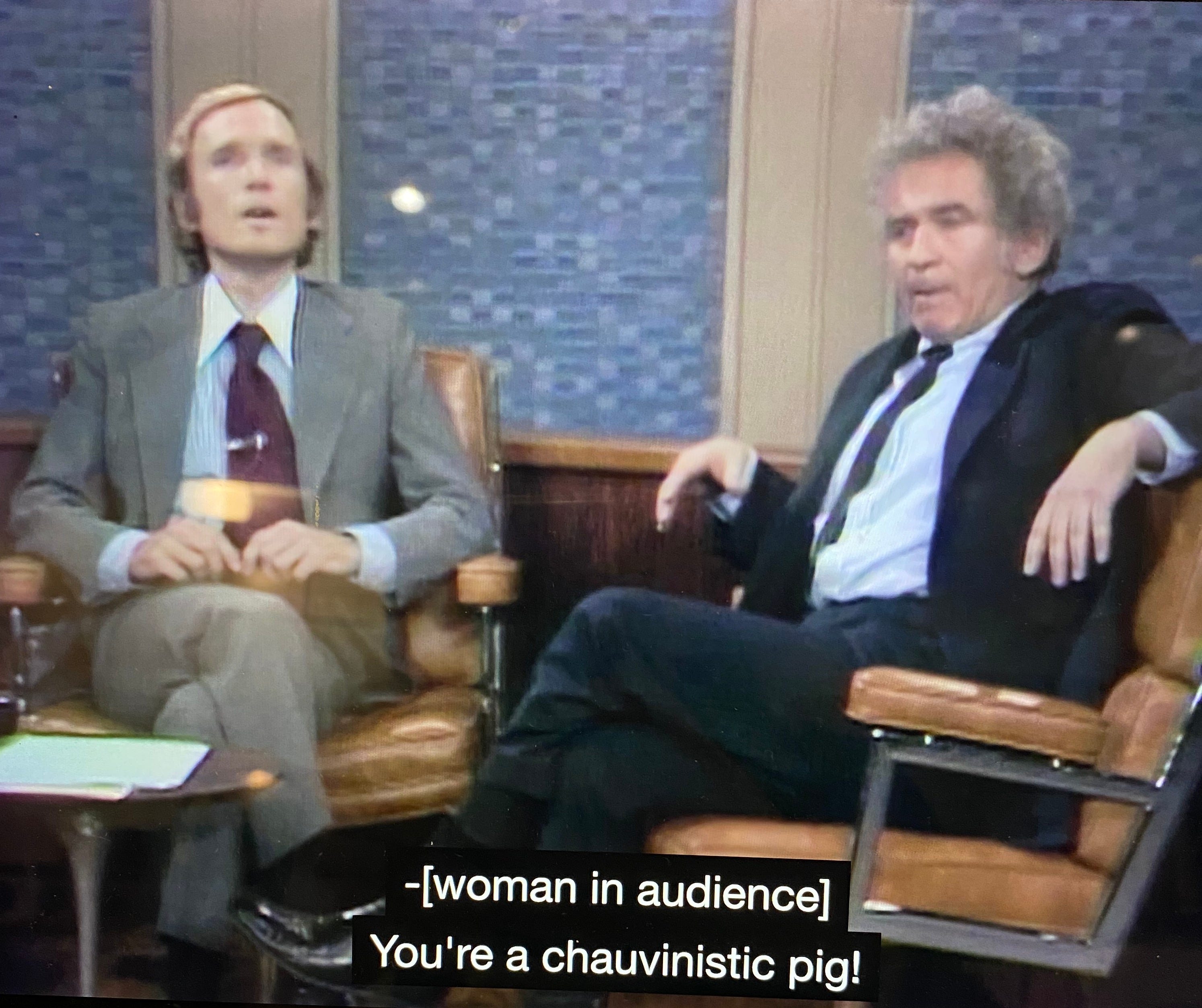
After several minutes of cutting remarks and poorly executed insults among those on the Cavett stage, Mailer poses an irritated, frustrated plea to the jeering audience to resist the use of dull, heavy-handed terms like “chauvinist pig” for the sake of their intellectual integrity as Americans. The plea will, predictably, fall on deaf ears, for the audience is a moronic entity, and, like the mob, is prone to turning on those who hold exceptional power over them.
The result is an episode worthy of The Simpsons in its parody of public discourse and brings to mind the off-the-cuff prediction Mailer made in Hall, that the “true perspective of the future is that it will end with nothing but assholes talking to assholes.” That Mailer was one such asshole only serves to emphasize his omniscience.
Given Mailer’s public stature in the last century, his near-total absence from this one is conspicuous, but not inexplicable: his blustering machismo, romantic approach to sex, and ferocious defence of traditional gender roles have little resonance for a generation bent on actualizing his most dire predictions. And yet, a posthumous return to relevancy is not out of the question, for the audience is starting to grow weary of the atrophying effects of self-censorship and cant, as indicated by the growing cottage industry of professional contrarians and hypocrisy whistle-blowers.
As with any endeavour, dissenting-opinion-haver is an occupation whose output ranges vastly in quality. What distinguishes Mailer, or anyone else whose appeal is largely to be stalwart in their opinions in public, from the masses of inane, disposable, culture-war vitriol, are the unmistakable and unfalsifiable qualities of charisma, authentic intelligence, and sincerity. The latter two qualities are particularly essential for the genuinely challenging work of identifying what it is one actually thinks about something, as disentangled from pernicious incentivisation (internalized desire to please or the reflexive desire to provoke) as possible. Meanwhile, charisma determines whether one will secure the audience’s attention in the first place, and Mailer was nothing if not a charismatic performer.
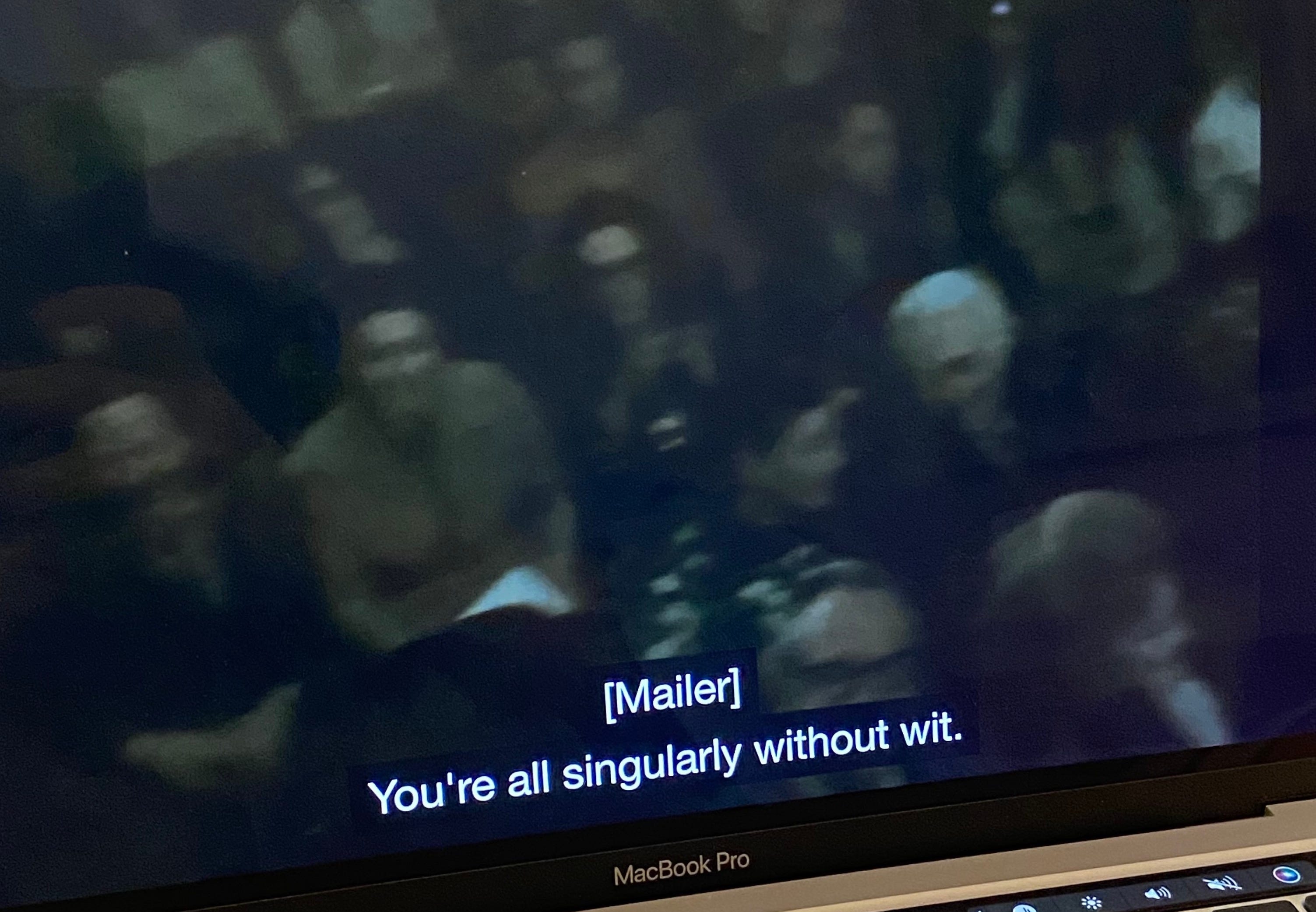
Unchecked contrarianism may have as insidious an effect on sound reason as cynical and conflict-avoidant agreeability. Mailer, and his contemporary counterparts (whether Elon Musk or some anon) may be as capable of “muddying the intellectual waters” as Gore or Millet, but he seemed generally earnest. In any case, his appearances on Cavett and Hall render this a middling concern amidst the exhilaration of watching the devil withstand the fire, while the angels waste away in the wings.
[1] Had I had the wherewithal to start this diary last year, I'd have written this on the 50th.
[2] Some years later the radical feminist Andrea Dworkin would come to the same conclusion.
I usually like my winners loud and my losers quiet but you’ve convinced me that there’s something of value in the vociferous lone moraliser.